Beer fermentation is an exclusive metabolic process of yeast (yeast converts sugars in wort into alcohol and carbon dioxide). If the material of the fermentation tank is prone to harboring bacteria or releasing harmful substances, it will directly damage the fermentation environment and cause beer spoilage (e.g., producing sourness, off-odors, or even turbidity).
Stainless steel, especially food-grade 304 and 316L grades, has a dense and smooth surface without pores or gaps, which effectively prevents bacteria from adhering and multiplying. Meanwhile, its stable chemical properties mean it will not contaminate the fermentation liquid like wood (which easily retains microorganisms) or ordinary carbon steel (which rusts and fosters bacteria). This ensures the beer remains pure throughout the 1–2 week fermentation cycle and meets food-grade hygiene standards.
During beer fermentation, the fermentation liquid itself contains acidic substances (such as lactic acid and acetic acid, with a pH typically between 4.0 and 4.5) and alcohol. After fermentation, the tank must be thoroughly cleaned and disinfected using strong alkalis (e.g., sodium hydroxide), strong acids (e.g., nitric acid), or high-temperature water to avoid residual yeast or miscellaneous bacteria affecting the next batch of brewing.
Ordinary metals (such as iron and aluminum) are easily corroded in acidic/alkaline environments, which not only causes rust to contaminate the beer but also shortens the tank’s service life. In contrast, stainless steel—especially 316L (which contains molybdenum)—has extremely high resistance to acids, alkalis, and alcohol. It can withstand long-term erosion from fermentation liquids and cleaning agents, preventing the leaching of metal ions (e.g., iron ions can darken beer color and impart a rusty taste) and ensuring the stability of beer flavor and quality.
Beer fermentation has strict temperature requirements:
Top fermentation (e.g., for ale beer) requires 15–25°C;
Bottom fermentation (e.g., for lager beer) requires 4–10°C.
Additionally, heat is released during fermentation (heat from yeast metabolism may raise the temperature and affect yeast activity). Therefore, fermentation tanks need good thermal conductivity and are equipped with an outer cooling jacket (through which cold water or refrigerant is circulated) to achieve precise temperature control.
The thermal conductivity of stainless steel (approximately 16–21 W/(m·K)) is much higher than that of glass (about 1 W/(m·K)) or plastic (about 0.2 W/(m·K)), allowing it to quickly transfer heat from inside the tank to the cooling jacket and maintain the fermentation temperature within the target range. Moreover, stainless steel has strong heat resistance (it can withstand high-temperature sterilization above 120°C) and will not deform or crack due to temperature fluctuations (e.g., high-temperature water for cleaning and low-temperature refrigerant for fermentation), making it suitable for long-term scenarios involving repeated temperature changes.
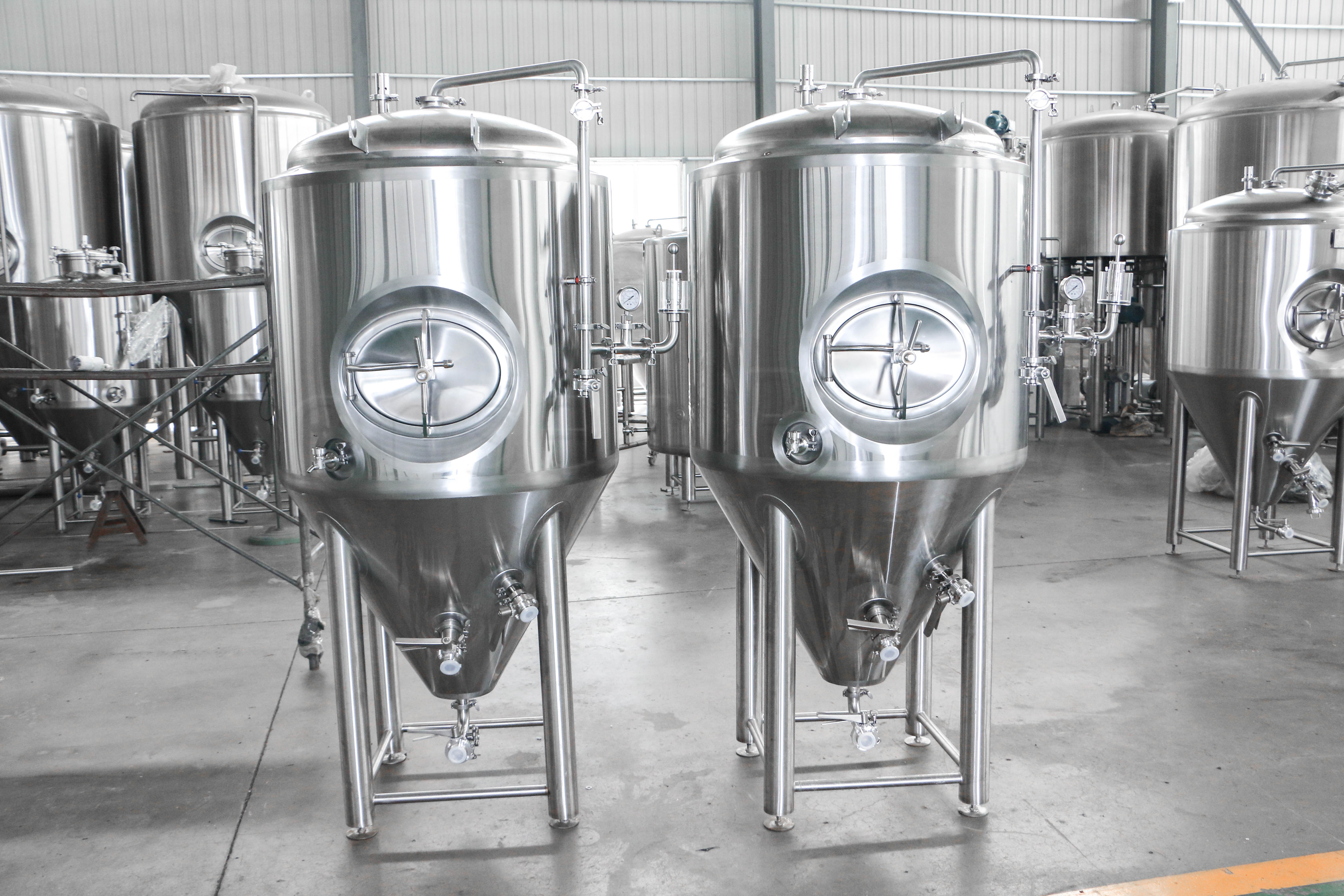
During beer fermentation, yeast produces a large amount of carbon dioxide, creating a certain pressure inside the tank (usually 0.1–0.3 MPa, with higher pressure for some high-carbonation beers). Insufficient tank strength or poor sealing may lead to air leakage, bulging, or even explosion risks.
Stainless steel has high mechanical strength (tensile strength of approximately 500–700 MPa), enabling it to withstand the internal pressure generated during fermentation. The tank can be seamlessly welded (reducing leakage points) and, when combined with silicone/PTFE gaskets, achieves long-term stable sealing. Furthermore, stainless steel tanks are resistant to deformation and impact (e.g., collisions during handling or cleaning) and have a service life of 10–20 years—far longer than glass tanks (easily broken) or plastic tanks (prone to aging and weak pressure resistance)—meeting the long-term usage needs of industrial-scale brewing.
Beer brewing must comply with strict food hygiene standards, and the cleaning efficiency of fermentation tanks directly affects the production cycle and costs.
The smooth, non-adsorptive surface of stainless steel allows residual fermentation liquid and yeast sludge to be quickly removed using a high-pressure water gun and cleaning agents—there is no need to worry about the material absorbing odors or stains (unlike plastic tanks, which easily absorb oil, or glass tanks, which are prone to breaking during cleaning). Additionally, stainless steel does not require frequent replacement (unlike plastic tanks, which need regular replacement due to aging). Daily maintenance only involves inspecting welds and gaskets, resulting in low maintenance costs. This makes it suitable for the production rhythm of large-scale breweries, from 100L tanks for microbreweries to 10,000L tanks for large-scale breweries.
If you want to choose suitable brewery equipment, we can customize exclusive solutions based on your workshop area and production volume.