
What are the 4 ingredients of beer?
Introduction
With the arrival of summer, the craze for drinking beer is coming at any time. So what are the main
ingredients of beer, and what equipment is used to make it?
1. Four ingredients of beer
Water
About 90% of beer is water. Water quality directly affects the final taste and chemical reaction process.
Deep minerals can give different flavors
Malt
Malt comes from barley. It provides fermentable sugars and aroma matrix required for fermentation.
It is the core of the main flavor of beer
Hops
Hops contain bitter acid and aroma oil, which balances sweetness and gives beer a fresh aroma. It is
common in various beer styles such as ale and lager
Yeast
Yeast converts sugar into alcohol and carbon dioxide through fermentation. Different strains determine
the style of beer, such as ale yeast and lager yeast
I. Fermentation Equipment
Fermentation Vessel / CCT
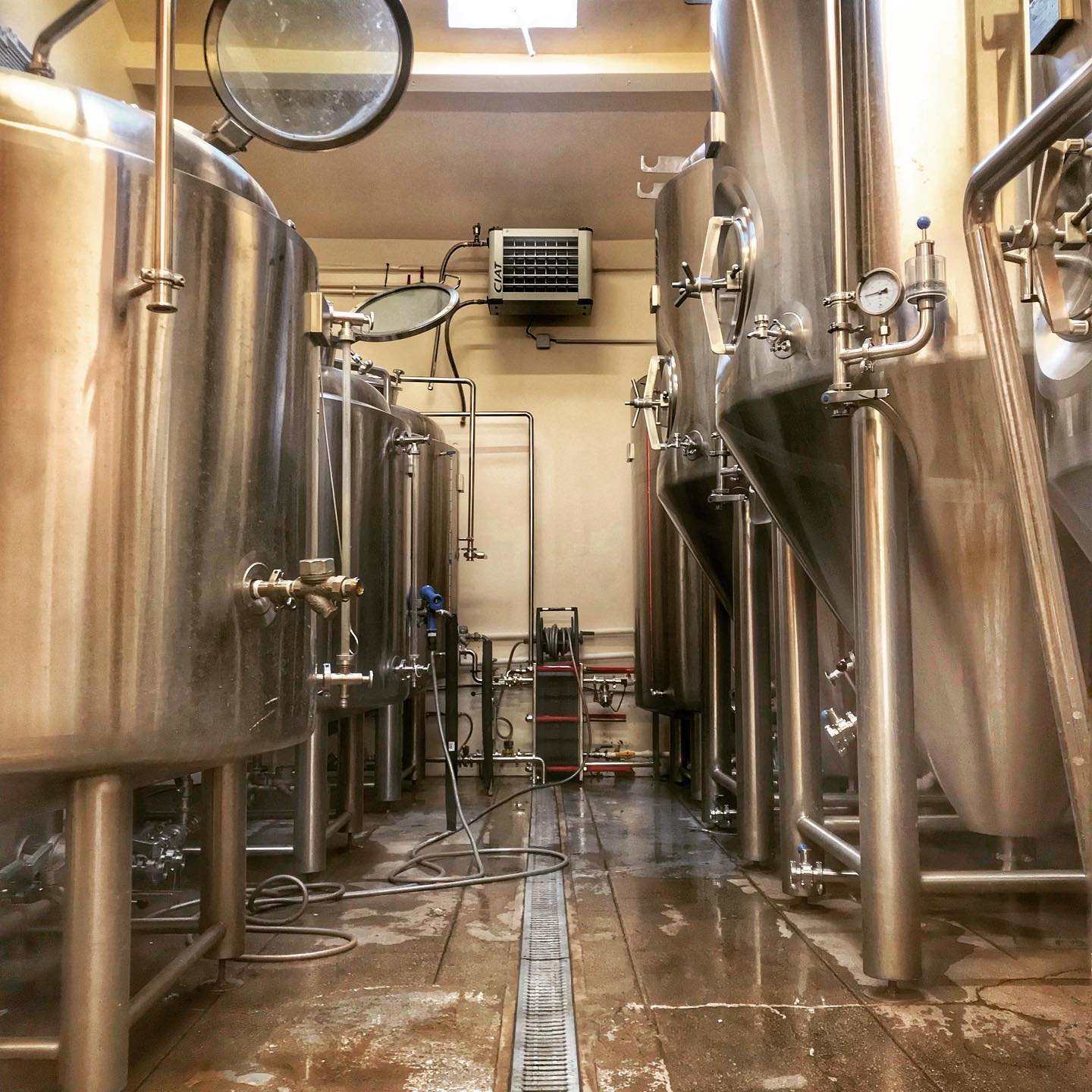
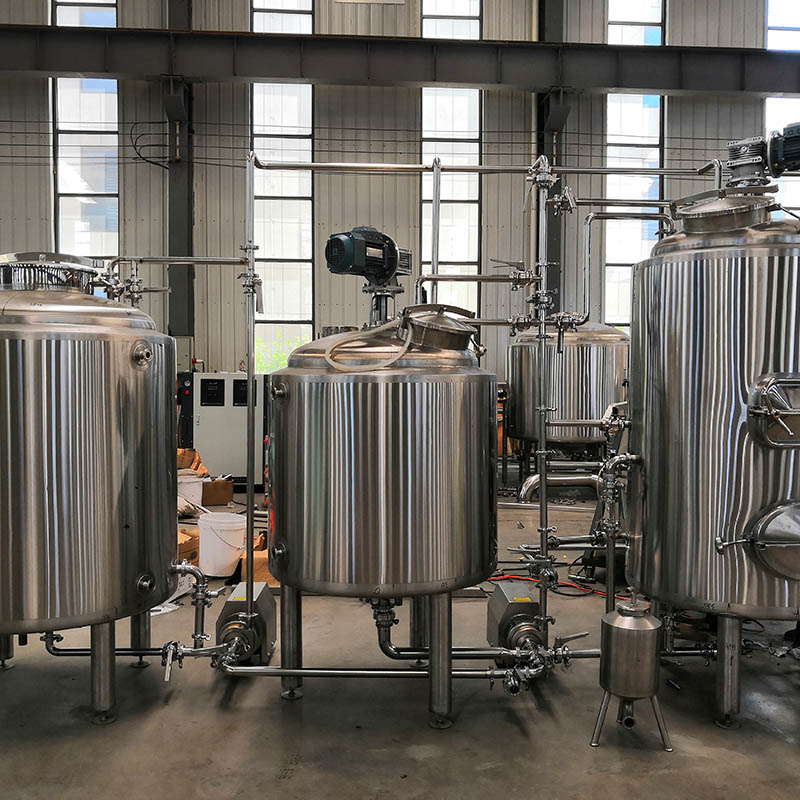
Fermentation tank, also known as Cylindrical Conical Tank (CCT), is the core component of beer production.
It is used to mix cooled wort with yeast and ferment at a controlled temperature. The industrial-grade
fermentation tank is made of food-grade 304 stainless steel, with mirror-polished inner wall and no
dead corner design. It supports CIP automatic cleaning to ensure hygiene and high beer yield.
Stainless Steel Pressure Fermenter
This type of fermenter adds a pressure-resistant design to the conventional tank body, which can
withstand a maximum operating pressure of 15 psi, realize in-situ carbonization in the tank, and
improve the delicate taste of beer and the stability of carbon dioxide. Equipped with a double-layer
cooling jacket, precision temperature probe and safety valve, the temperature control accuracy can
reach ±0.1℃, and supports top/side manholes and gas-controlled sampling to meet the strict process
requirements of large breweries.
Best Conical Fermenter
The conical bottom is designed as a 60° cone, which can efficiently concentrate the precipitation of
yeast mud and impurities, making unloading convenient, the supernatant clearer, and the beer yield
higher. With the 360° rotating spray ball and CIP cleaning arm, the cleaning cycle is greatly shortened,
labor costs are reduced, and production switching is fast and sterile.
Unitank Fermenter
Unitank integrates fermentation, maturation, carbonization and storage, replacing the traditional tank
mode, saving space and pipeline investment. The Unitank produced by Tonsen adopts an overall
mirror-polished inner wall, a polyurethane insulation layer and a high-efficiency heat exchange jacket,
supports in-situ cleaning and carbonization, greatly shortens the production cycle and eliminates
secondary pollution.
2. Mashing Equipment
The saccharification system includes a malt grinder, a saccharification pot and a filter tank. The malt
grinder is responsible for grinding the malt to a suitable particle size so that the starch and water are
fully in contact; the saccharification pot maintains a constant temperature of 62-68℃ to achieve the
decomposition of starch into fermentable sugars; the filter tank is rinsed with hot water to separate
soluble sugars. Tonsen provides a double-roller malt grinder with a capacity of 300kg/h, and supports
continuous and batch saccharification processes, compatible with the two traditional and modern
brewing methods of soaking and porridge.
3. Brewing Equipment
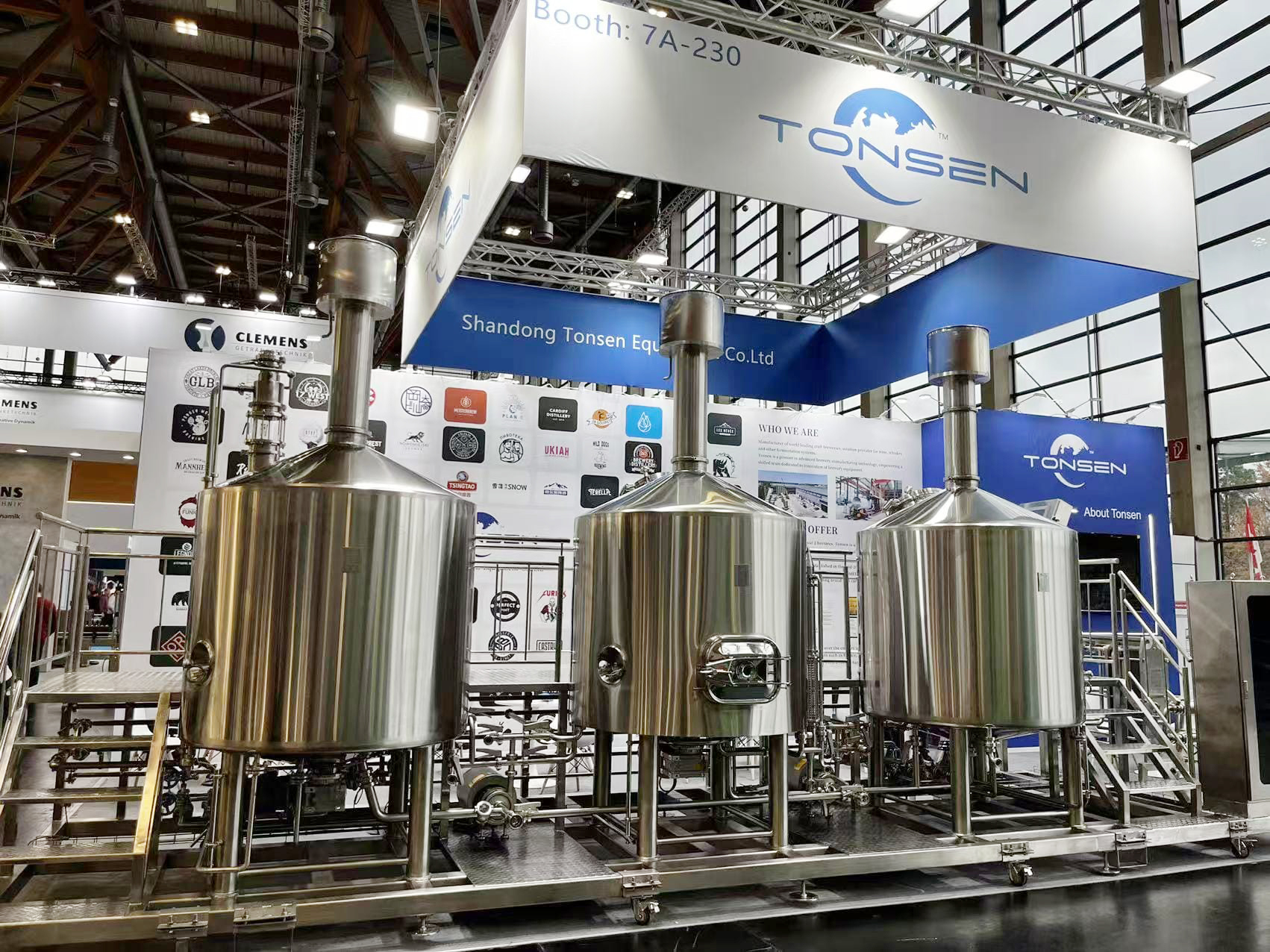
Three-vessel Brewhouse
This system integrates the saccharification pot, filter tank and boiling/vortex pot, and the process is
seamlessly connected. Tonsen's 1000L model uses a laser-welded 304 stainless steel structure, supports
multiple heating methods, and can be controlled by a PLC to achieve fully automatic monitoring of
temperature, flow rate, and boiling time to ensure the consistency of each batch of products.
Boiling Kettle & Whirlpool
The boiling kettle is responsible for sterilizing the wort and extracting the bitterness and aroma of hops.
It is usually equipped with a high-efficiency steam or electric heating system; the whirlpool uses centrifugal
force to separate the spent grains, improve filtration efficiency, and obtain clarified wort.
IV. Ancillary Equipment
Heat Exchanger
It is used to quickly cool the high-temperature wort to the yeast inoculation temperature (18–22℃).
The cooling medium can be cooling water or ethanol solution, and the area can be customized according
to production capacity requirements.
Cooling System
It consists of a cold water/ethanol kettle and a screw chiller, with a cooling capacity ranging from 100L
to 4000L, ensuring stable fermentation and maturation temperature control.
CIP Cleaning System (CIP System)
Including cleaning tanks, disinfection tanks and circulation pumps, all equipment is cleaned without
dead corners through CIP arms and spray balls, significantly shortening cleaning time and saving
chemicals.
Yeast Management and Oxygenation System (Yeast & Oxygenation)
Independent yeast tanks are used for yeast cultivation and rejuvenation. The wort oxygenator injects
oxygen into the wort before inoculation to ensure healthy yeast reproduction and optimize fermentation
efficiency.
V. Commercial Brewing System (Commercial Brewing System)
The modern commercial system covers the entire process automation solution from grinding, saccharification,
boiling, cooling, fermentation to filtration and filling. Tonsen can provide customized production lines from
100L to 10,000L, and can be expanded to large-scale projects with an annual output of 50,000 tons.
The equipment layout, pipeline design and degree of automation can be customized as needed.
6. Brewing Equipment Companies
Major global manufacturers include:
– Shandong Tonsenbrew: provides a full range of equipment from 100L to 10,000L, with complete R&D,
manufacturing and service capabilities;
– Krones AG (Germany): specializes in automated packaging and sterilization systems;
– Alfa Laval (Sweden): specializes in thermal and fluid handling equipment;
– Paul Mueller (USA): expert in large stainless steel containers;
– Praj Industries (India): provider of new energy and fermentation process equipment.
7. In-depth introduction of Tonsen
Company qualifications and scale
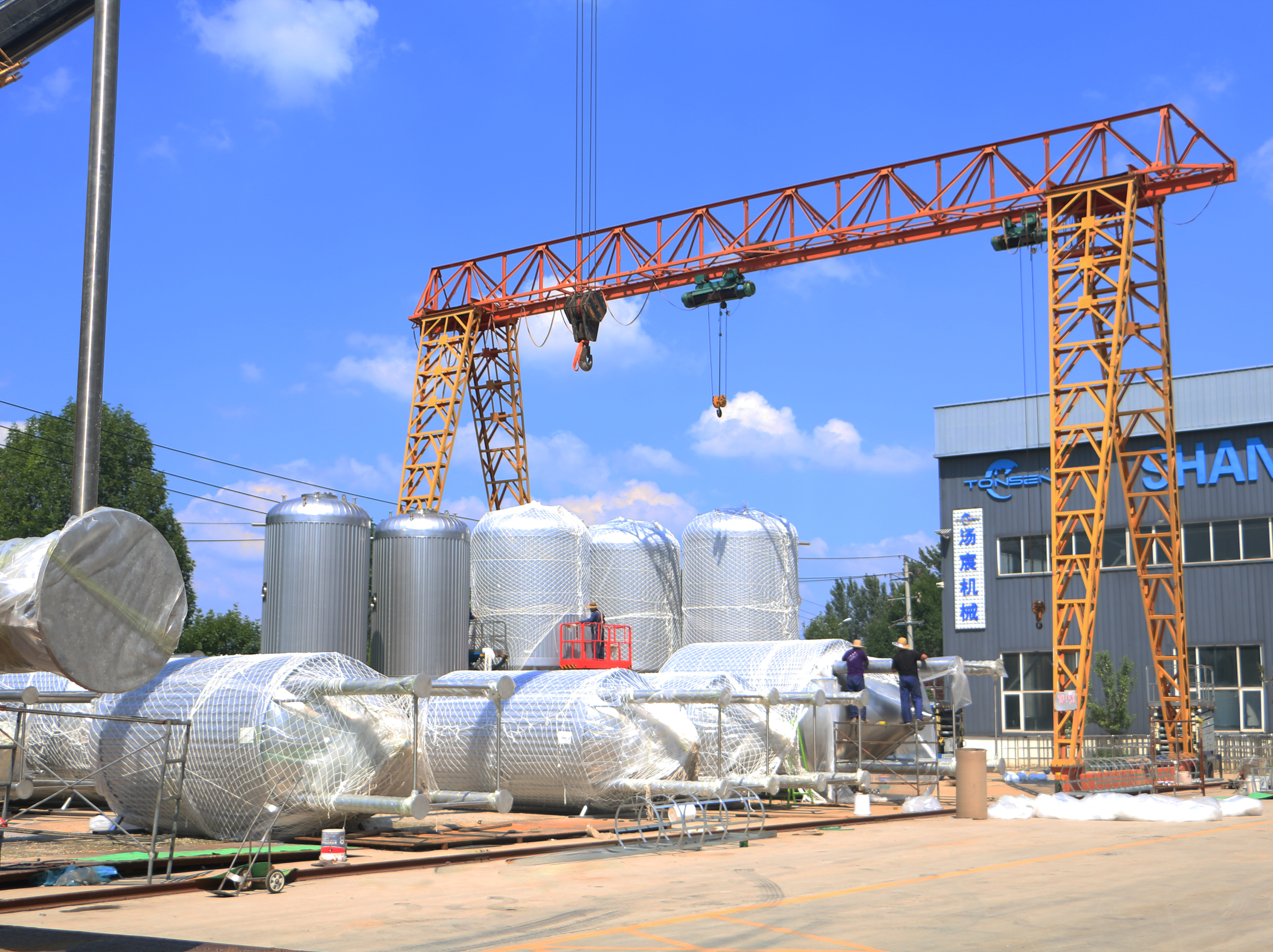
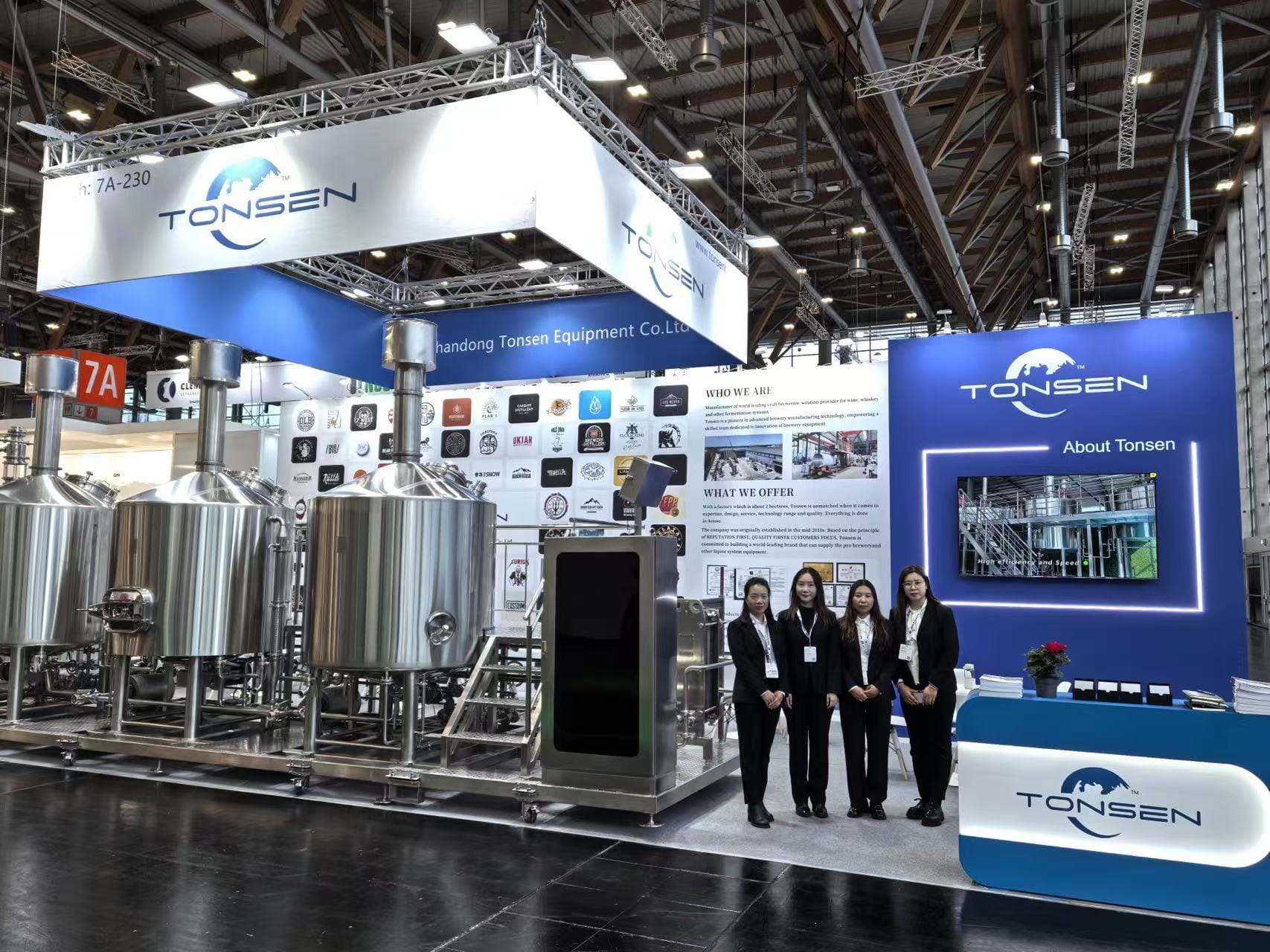
Located in Jinan, Shandong, it covers an area of 20,000 square meters and has a Class D pressure vessel
production license, ISO9001, CE, TÜV and other international certifications, with an annual production
capacity of more than 500,000 sets.
Advanced manufacturing and continuous R&D
Equipped with laser cutting, automatic welding, CNC processing and large mirror polishing equipment,
it can realize the processing of the whole series of products from 100L to 200kL, with a cutting accuracy
of ±0.1mm; it has a special laboratory and cooperates with international brands to continuously optimize
energy saving and automation processes.
Professional technical team
The R&D team has more than 70 people, including 8 senior engineers and more than 30 members with
bachelor's degrees or above, with an average industry experience of 20 years. It has in-depth cooperation
with Siemens, ABB and others to ensure that the system solution is scientific and reliable.
Global service network
The products are exported to more than 70 countries in Europe, America, Africa and Southeast Asia.
It has a localized installation and commissioning team and training center, providing overseas technical
response within 72 hours, 2-year warranty and lifelong maintenance.
Representative customer cases
– Guinness St. James Gate Factory: Using Tonsen stainless steel pressure fermentation tanks to achieve
nitrogen carbonization and delicate foam;
– Budweiser North American Craft Brewing Workshop: Introducing Tonsen Unitank, the single tank
capacity is 2,000L, the automation level is increased by 30%, and the energy consumption is reduced
by 15%.
8. Cost & Procurement (Brewery Equipment Cost & For Sale)
Depending on the production capacity and degree of automation, the cost of nano/micro-level (1-10BBL)
equipment is about US$50,000-250,000, medium-sized (10-50BBL) is about US$250,000-1 million, and
large-sized (above 50BBL) is over US$1 million. Tonsen offers a variety of trade terms and installment
plans, and can design equipment layout for free.
9. Conclusion
Through a comprehensive interpretation of fermentation equipment, saccharification equipment,
brewing equipment and auxiliary systems, combined with a comparison of major manufacturers and
an in-depth analysis of Tonsen, this article provides a one-stop commercial production solution for
breweries. Choosing Tonsen will not only provide industry-leading equipment and processes, but also
enjoy the full support of a professional team and global after-sales service, helping customers reduce
costs, improve efficiency, and gain market competitive advantages.